The Couch Economy Is Quietly Rewriting Your Budget
Staying in is not the same as spending less. The useful question is what each convenient evening actually costs.
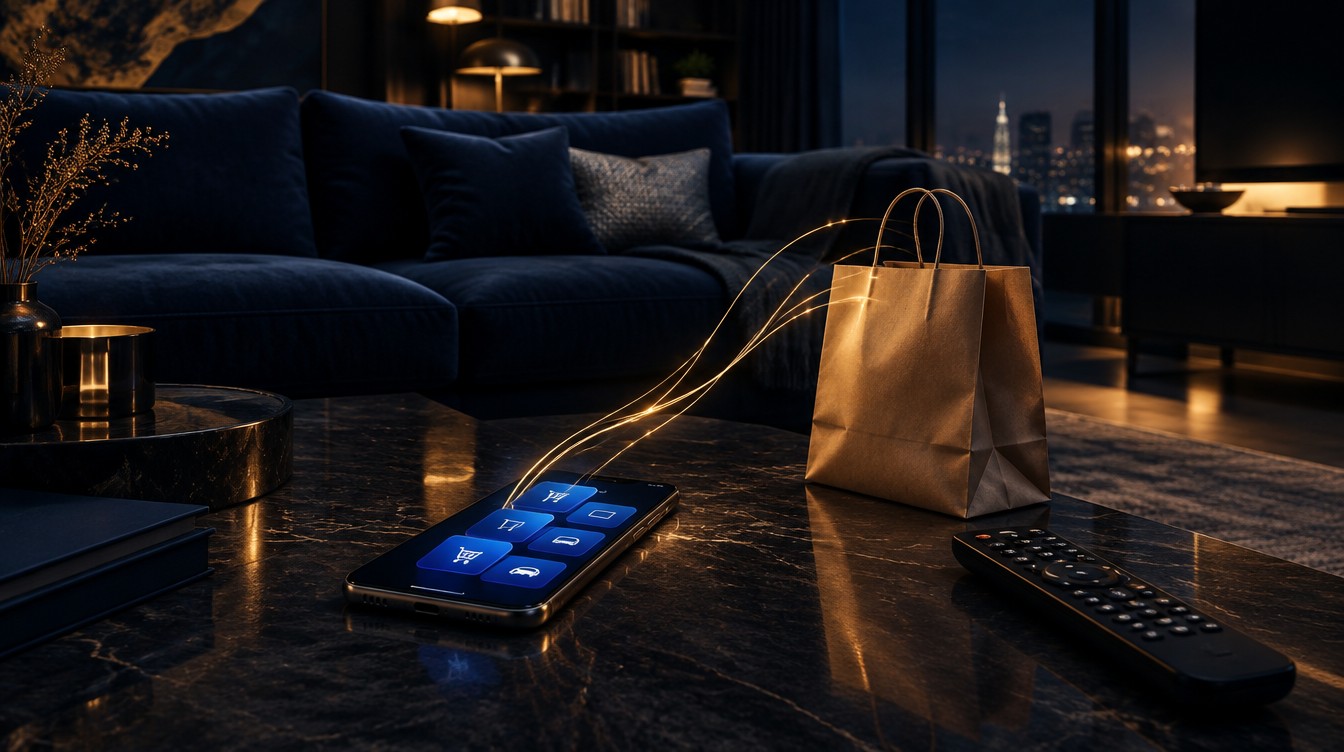
You stayed in. So why did the evening still cost money?
Imagine a Friday with no taxi, no restaurant booking and no tickets. There is a takeaway order, a film subscription and a small purchase made while deciding what to watch. None feels like a night out. Together, they are still a night of spending.
That is the question behind the couch economy: not whether the sofa is expensive, but whether we still notice all the decisions we make from it.
What the research actually says
Visa Business and Economic Insights published its couch-economy research on 14 September 2026. Its analysis uses anonymized VisaNet credit, debit and prepaid-card transactions across Australia, Brazil, Poland, the United Arab Emirates, the United Kingdom and the United States. [1]
Between 2019 and 2026, the reported online-and-in-app share of domestic payment volume rose from 48% to 58% in the U.S., 10% to 24% in Poland and 35% to 55% in the UAE. In the U.S., streaming subscriptions appeared on more than 17% of cards, versus roughly 6% for cinema and concert spending. [1]
Those are network observations, not a census of people or household budgets. A card is not a person; a channel share is not proof that an individual spent more. The report does not tell us whether your particular evening was a saving. That requires your own comparison.
The rest is a budget thought experiment
The examples and product implications below are OLECH analysis. They are not additional findings from Visa's research.
Consider two evenings. In the first, you planned to go out but ordered dinner instead. In the second, you had already bought groceries but ordered the same dinner anyway.
The checkout total could be identical. Its meaning in the budget is not.
The first purchase might replace a more expensive plan. The second might be an extra purchase alongside food you already paid for. Calling both evenings a saving because you stayed home misses the comparison that matters: what spending actually disappeared?
This is why a useful budget needs a counterfactual, not a moral judgment. Convenience can be worth paying for. The question is what you are paying instead of, or in addition to.
One evening, several decisions
A room can look quiet while a transaction history looks busy.
A hypothetical customer orders dinner, adds a delivery membership because it changes the price shown, rents a film outside an existing subscription and buys something advertised during a break. Each decision has its own justification. None of the screens needs to show the entire evening.
A bank statement eventually brings those payments together, but it does so after the choices have been made. The interesting design problem is whether a money app could make the combined picture useful sooner, without treating every small purchase as a mistake.
Imagine an optional evening total, or a weekly view that separates planned recurring charges from spontaneous purchases. The value would not come from a louder warning. It would come from putting related decisions next to each other.
The arithmetic of a convenient routine
Take a deliberately invented example: three weekly orders each carry an additional EUR 3 in costs you would not otherwise incur. Over four weeks, that is EUR 36. Add two unused EUR 10 monthly subscriptions and the total becomes EUR 56.
These numbers are illustrative, not reported averages or a claim about any platform's fees. Your actual costs could be lower, higher or zero; an order could also replace a more expensive alternative.
The point is the method. Name a repeated behaviour, identify its genuinely additional cost, and multiply by how often it happens. Then distinguish the subscriptions you use from the ones you merely still have.
A single charge can look insignificant because you are viewing one instance. A routine is a different unit of analysis.
Paying for time can be rational
There is another side to this comparison. A delivery can protect an hour of rest, make an exhausting day manageable or solve a practical accessibility problem. An entertainment subscription can be excellent value for someone who uses it regularly.
A budget that ignores those benefits is not more rigorous. It is simply missing part of the decision.
The useful comparison is not convenience against virtue. It is the actual price against the actual benefit for the person making the purchase. Time, reliability, effort and enjoyment belong in that conversation alongside money.
The risk in our hypothetical evening is not that someone chose convenience. It is that a series of default choices could make the total difficult to see.
What a fintech could do differently
Suppose a financial app wanted to help rather than simply label the spending. It could answer three concrete questions: which payments repeat, which services are still being used, and what changes when a promotion ends?
That would require care. A payment feed alone may not establish usage. A merchant name may not identify the exact subscription. The app should make uncertainty visible rather than present a guess as a confirmed cancellation opportunity.
An honest product might say, "This appears to recur monthly," then let the customer confirm what it is. It could show the next expected charge while clearly separating an estimate from a contractual amount.
The opportunity is a clearer picture of commitments, not another screen that tries to decide the customer's lifestyle for them.
A smaller experiment than cancelling everything
For one week, a reader could group the purchases made during evenings at home and ask what each one replaced. Keep the exercise descriptive: planned purchase, recurring service, unplanned extra or unclear.
Then examine one routine rather than imposing a new rule on every purchase. Was a membership used enough to justify its price? Was a delivery a deliberate choice or simply the first option on the screen? Would the same choice still feel worthwhile with the month's total beside it?
There is no universal answer. That is precisely why the total should be visible.
What to watch
For consumers, the useful outcome would be convenience that remains easy to understand after the payment, not just easy to buy before it.
For product teams, a worthwhile test is whether the customer can explain their recurring commitments and recognise the trade-offs they are making. A dashboard that looks polished but hides uncertainty would not pass that test.
Staying in can still be cheaper. It can also be more comfortable, more practical or more enjoyable. None of those possibilities makes the individual checkouts disappear.
The couch economy becomes a budget story when we stop asking where the evening happened and start asking what, exactly, we paid for.
Source and scope
[1] Visa Business and Economic Insights, 14 September 2026: Visa Research: The Rise of the Couch Economy Is Reshaping Consumer Spending. Corporate newsroom version.
The factual figures above are attributed to Visa's own network research. The two links carry the same release, not two independent studies. The household scenarios, euro amounts and proposed app features are illustrative OLECH analysis, not measured effects, product claims or individual financial advice.
- #consumer finance
- #internet culture
- #subscriptions
- #digital payments